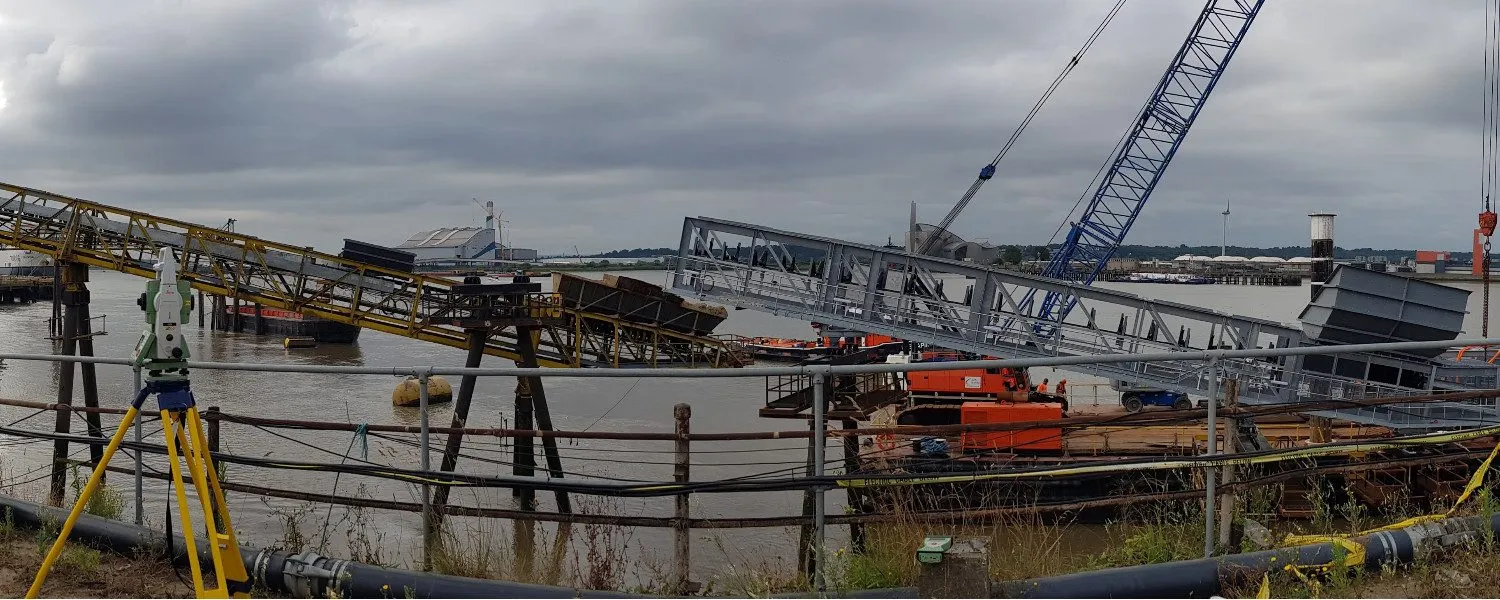
Dagenham, London
Riverside aggregates wharf, Dagenham
Piling setting out, Volume surveys, Remote monitoring and alerts

Services
Movement, settlement, crack, tilt and vibration monitoring for structural engineers, party wall surveyors and main contractors. Readings to ±1mm, reported within 24 hours of every visit, with same-day alerts when triggers are breached.
Full member of The Survey Association, the UK trade body for survey companies.
Fixed price, confirmed timescales, no surprises on the invoice.
Over 2,000 surveys, from home extensions to nuclear power stations.
£1m professional indemnity and £5m public liability cover.
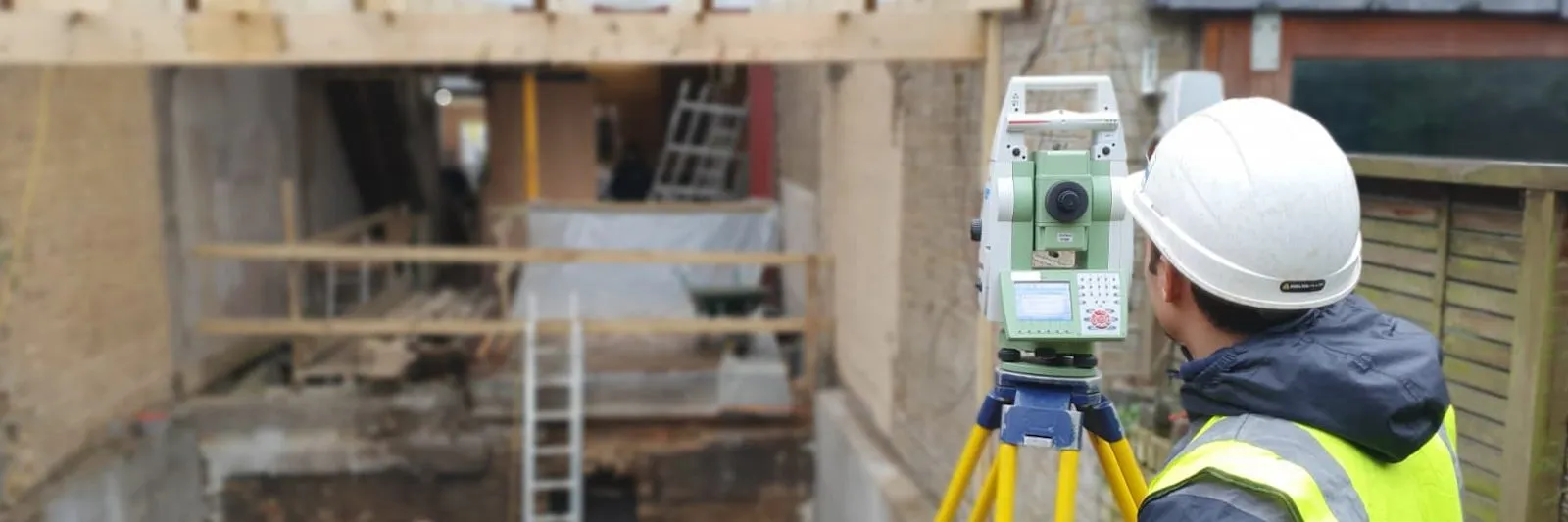
A movement monitoring survey measures how a building, retaining wall or earthwork moves over time. Targets, prisms or sensors are fixed at agreed positions and resurveyed at set intervals with high-precision total stations, digital levels or automated sensors. Each round is compared with the baseline, giving vertical, horizontal and 3D movement to within a millimetre.
If movement crosses a trigger, the project team hears about it straight away so works can be paused, reviewed or remediated. The result is a documented record of how the structure behaved, which protects the engineer’s design assumptions, supports party wall awards, satisfies insurers and gives the contractor evidence if a third party makes a claim.
We cover all 32 London boroughs, with most basement work in Westminster, Kensington and Chelsea, Camden, Hammersmith and Fulham, Wandsworth and Richmond, and regular schemes across Essex, Kent, Surrey, Hertfordshire and Berkshire.
Independent crack monitoring that shows whether movement is progressive, seasonal or stable. Manual Demec readings to a hundredth of a millimetre, or automated sensors with alerts, reported for engineers, insurers and homeowners.
Remote vibration monitoring for piling, demolition, compaction and breaking-out works. Tri-axial geophones record peak particle velocity to BS 7385 and BS 5228, with alerts around the clock.
Wireless tilt sensors fixed to walls, columns, retaining walls and temporary works, reading continuously and alerting you if rotation passes a set threshold.
Vertical movement measured to ±0.5mm by precise levelling, from wall-mounted points read with digital levels and reported against baseline after every visit.
A robotic total station in a fixed enclosure reads a network of prisms on a schedule, often hourly, uploading 3D movement to a dashboard and alerting the team the moment a trigger is breached.
Independent monitoring of party walls and adjoining buildings during basements, underpinning, extensions and demolition, reported in a format that drops straight into the party wall award.
Movement monitoring of neighbouring buildings and retaining structures through basement dig-down, underpinning, raft pour and waterproofing, reported within 24 hours of every visit.
Movement monitoring of tunnels, rail structures and underground assets affected by nearby construction, surveyed and reported to the requirements of the asset owner's protection agreement.
Automated sensors and instruments that report remotely, with a live dashboard for the project team and SMS and email alerts when readings pass amber or red triggers, day or night.
We quote within one working day, to a specification you or your engineer have prepared, or one we write.
Targets, prisms, sensors or studs are fixed in agreed positions, with an off-site control network outside the zone of influence.
Two independent baseline surveys before any works start. It is the most important visit on the job and we will not skip it under pressure.
Weekly through excavation, piling and underpinning, then fortnightly or monthly. A PDF report follows within 24 hours of every visit.
If an amber or red trigger is breached, the named site contact is told the same day. We do not wait for the next scheduled report.
Targets are removed at the end of the works, or left for a future re-baseline on phased projects.
We charge per visit on a clear, line-item basis. No retainers, no minimum contract length and no surprise mobilisation fees.
| Typical job | Guide price |
|---|---|
| Setup, residential basement in London | £500 to £1,000 |
| Each monitoring visit, including the report | £200 to £400 |
| Automated and vibration monitoring | Fixed monthly cost |
Prices exclude VAT. Commercial, infrastructure and international projects cost more, on the same per-visit basis.
Monitoring specified as part of temporary works design or a basement impact assessment.
Pre-works baselines and ongoing readings to discharge duties under the Party Wall etc. Act 1996.
Monitoring under CDM obligations or planning conditions, reported in a format that drops into your records.
Dagenham, London
Piling setting out, Volume surveys, Remote monitoring and alerts
★★★★★
We have used THS Concepts for multiple surveys from topographic to drone photogrametry, they are professional and prompt and deliver exactly what is requested. Highly recommended.
★★★★★
We was looking for a local company to survey our setting out on our new build project and came across THS, We are VERY happy with the service they provided, Tom visited the site and was very helpful and professional. providing a detailed description and was very thorough. we will defiantly be using THS in the near future.
★★★★★
I contacted Tom to carry out a Topographic survey, and cannot recommend them enough. Nothing was to much, and I was kept up to date with everything as it happened! Great company to deal with and reasonably priced.
Before any works begin. A baseline taken after enabling works have started is a midpoint, and any movement during enabling works will be invisible. We take a minimum of two pre-works surveys.
±1mm in 3D for total station observations of prisms at normal building distances, and ±0.5mm vertically for precise levelling. Automated systems achieve similar accuracy with continuous data.
The works drive the schedule, not the calendar. Weekly during excavation, underpinning and piling, fortnightly or monthly during steel erection and slab pours, then less often through fit-out. We agree it with the engineer or party wall surveyor and adjust as conditions change.
Triggers should be set by the structural engineer from the structure's tolerance, not by the surveyor. Typical London residential basement triggers are around 5mm amber and 10mm red for total movement, but heritage buildings and assets near TfL, Network Rail or Thames Water often need much tighter values.
Yes, if it was collected from a stable, independent control network with proper baselines and consistent reporting. Our data has been used in expert witness reports.
Basement projects typically run 6 to 18 months. Subsidence cases often need 12 months or more. Infrastructure schemes run for years, and we have schemes running for over five.
Gridlines, foundations, piles and roads set out on site.
Point clouds and BIM models of buildings, plant and structures.
Site levels, features and boundaries for planning and design.
Send a location, a rough brief and your deadline. We reply with a fixed quote within 24 hours.