
Tilt monitoring with wireless inclinometers
Wireless tilt sensors fixed to walls, columns, retaining walls and temporary works, reading continuously and alerting you if rotation passes a set threshold.
What tilt sensors measure
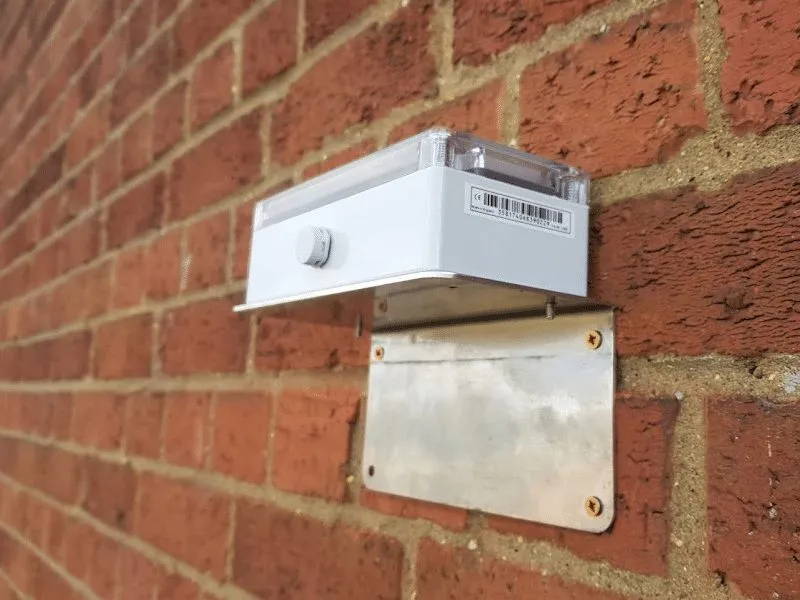
A tilt sensor, also called an inclinometer, measures the angle of the surface it is fixed to and records how that angle changes over time. It is the right tool when a structure is more likely to rotate than to move bodily: a retaining wall leaning out, a party wall rotating as the ground next to it is excavated, or a temporary works prop starting to deflect.
Why use them
Tilt sensors give continuous, real-time readings without anyone needing to visit, so they act as an early warning between survey visits. They are small, quick to install, suit a wide range of structures and conditions, and are cost-effective for long monitoring periods.
Typical uses
Retained facades during demolition and rebuild, party walls next to basement excavations, retaining walls and embankments, chimneys and gable walls, and temporary works such as props, needles and scaffolds. In each case the engineer sets amber and red values for rotation, usually in degrees or millimetres per metre, and the sensor checks them every few minutes, day and night.
Alerts and data
Readings go to our remote monitoring dashboard, where the project team can see every sensor over time. If a value passes a trigger, the named contacts get an SMS and email straight away, and we follow up the same day. Because the sensors read continuously, they also show when movement happened, which often ties it to a specific activity on site.
Part of a wider scheme
Tilt monitoring rarely runs on its own. We usually combine it with total station movement monitoring and vibration monitoring so the engineer sees rotation, displacement and vibration side by side.
How it works
Agree positions and triggers
We agree where rotation matters and what thresholds apply with the structural engineer.
Install
Sensors are fixed with minimal intrusion and set up to transmit readings remotely.
Monitor
Readings arrive continuously, with alerts the moment a threshold is passed.
What it costs
Tilt sensors are charged per sensor per week, including the dashboard and alerts, so long schemes stay affordable.
| Typical job | Guide price |
|---|---|
| Wireless tilt sensor, per week | About £30 per sensor per week |
| Installation and removal | Quoted to the scheme |
Prices exclude VAT. The weekly rate includes the dashboard and alerts.
Who we work with
Structural and temporary works engineers
Continuous rotation data on retaining walls, props and retained facades.
Basement and demolition contractors
Early warning on party walls and adjoining structures during the works.
Party wall surveyors
Tilt readings reported alongside movement and crack data for the award.
Asset owners
Long-term records of walls, chimneys and structures that may be rotating.
Where we work
From our base in Leigh-on-Sea, Essex, we carry out tilt monitoring across London, Essex, Kent, Hertfordshire and the rest of the UK. Local pages:
What clients say
Read all 90+ reviews on Google★★★★★
THS Concepts carried out movement monitoring for us during a large renovation in Leigh on Sea, needed as part of our party wall awards. Reliable readings throughout, kept us updated regularly and gave us real peace of mind during the works. Would recommend!
★★★★★
THS Concepts provided Echo Construction Group with regular movement monitoring surveys which have been off great use during our basement excavation works and recommend them!
★★★★★
Truly excellent Company and Staff. I tendered several Monitoring companies and THS Concepts communication via email was perfect. The Fees were reasonable and I was more than comfortable going ahead with them. …
Tilt monitoring: common questions
When is tilt monitoring the right choice?
When the likely failure mode is rotation rather than translation, for example a retaining wall, a party wall during excavation, a chimney, a column or a temporary works prop or scaffold.
Can tilt sensors be combined with other monitoring?
Yes. They often run alongside total station prism monitoring and vibration monitoring on the same site, giving rotation, movement and vibration in one scheme.
Do the sensors damage the structure?
No. Installation is minimally invasive, using small fixings, which suits occupied and listed buildings.
Guides
Related services
- 3D laser scanning
Point clouds and BIM models of buildings, plant and structures.
- Setting out
Gridlines, foundations, piles and roads set out on site.
Tell us about your site
Send a location, a rough brief and your deadline. We reply with a fixed quote within one working day.