
Basement excavation monitoring
Movement monitoring of neighbouring buildings and retaining structures through basement dig-down, underpinning, raft pour and waterproofing, reported within 24 hours of every visit.
The bulk of our London monitoring
Basement excavations are the most common reason we are appointed in London. We baseline the affected and adjoining structures, monitor through dig-down, underpinning, raft pour and waterproofing, then reduce frequency through the superstructure and fit-out.
Planning and monitoring requirements
Many London boroughs require a Basement Impact Assessment with the planning application, and a Construction Management Plan before work starts. Both commonly set out how the neighbouring buildings will be monitored: which structures, which methods, how often, and the trigger levels at which work stops. Party wall awards add their own requirements. We work to whichever document sets the strictest terms, or help the engineer write the monitoring specification if one does not exist yet. For an overview of all our methods, see structural movement monitoring.
Methods
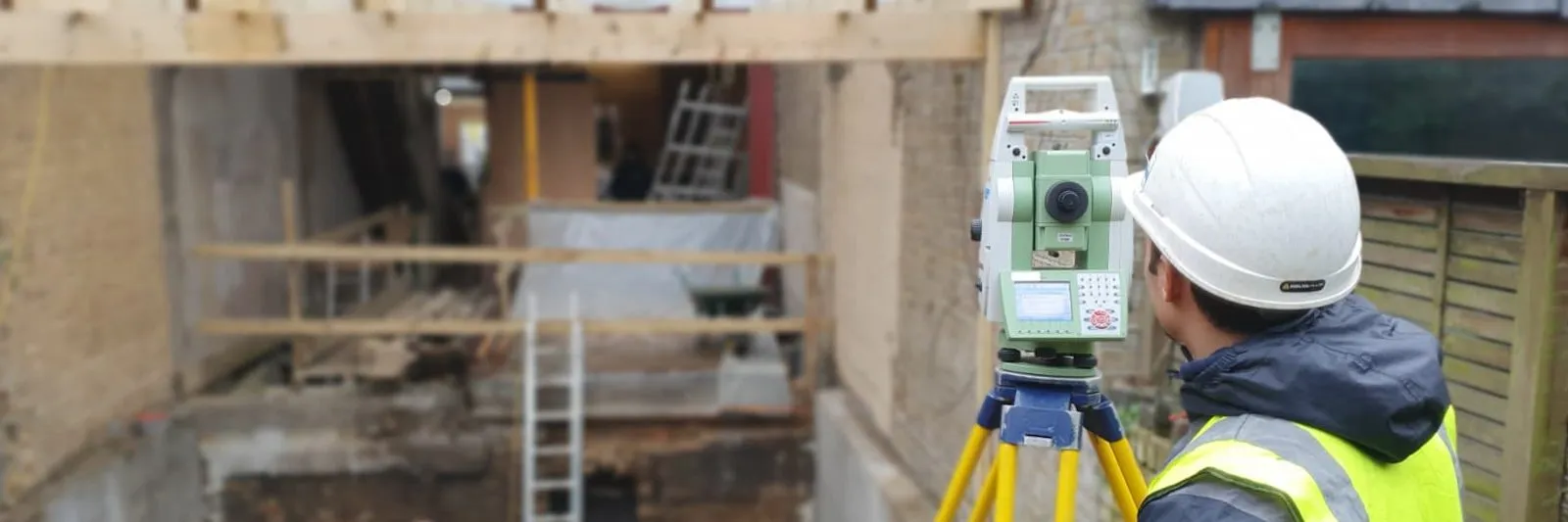
Prism targets on the adjoining buildings are read with 1-second total stations from a stable control network, typically to ±1mm. On higher-risk basements, automated total station monitoring reads the targets around the clock. Where specified we add precise levelling, crack monitoring on neighbouring walls and tilt sensors on retaining structures.
Across London
We cover every London borough; see structural monitoring in London for how London schemes run. Where a party wall award is in place, see party wall monitoring.
How it works
Specification
Work to the monitoring requirements in the Basement Impact Assessment, party wall award or engineer's specification.
Baseline
Install targets and take two baseline surveys before any works begin.
Through the dig
Weekly readings through excavation and underpinning, reducing through superstructure and fit-out.
What it costs
Basement schemes are priced per visit: a setup with two baselines, then weekly visits through the dig, reducing later. Automated tilt and vibration sensors are about £30 per sensor per week.
| Typical job | Guide price |
|---|---|
| Setup, including baseline readings | £600 to £1,200 |
| Each monitoring visit, including the report | £200 to £400 |
Prices exclude VAT. Larger commercial and infrastructure schemes are quoted to the specification.
Who we work with
Structural engineers
Monitoring specified in a Basement Impact Assessment or temporary works design.
Basement contractors
Clean data to keep works moving and defend against claims.
Party wall surveyors
Reports ready to go straight into the award file.
Where we work
From our base in Leigh-on-Sea, Essex, we carry out basement excavation monitoring across London, Essex, Kent, Hertfordshire and the rest of the UK. Local pages:
What clients say
Read all 90+ reviews on Google★★★★★
THS Concepts carried out movement monitoring for us during a large renovation in Leigh on Sea, needed as part of our party wall awards. Reliable readings throughout, kept us updated regularly and gave us real peace of mind during the works. Would recommend!
★★★★★
THS Concepts provided Echo Construction Group with regular movement monitoring surveys which have been off great use during our basement excavation works and recommend them!
★★★★★
Truly excellent Company and Staff. I tendered several Monitoring companies and THS Concepts communication via email was perfect. The Fees were reasonable and I was more than comfortable going ahead with them. …
Basement excavation monitoring: common questions
Do London boroughs require basement monitoring?
Many London boroughs require a Basement Impact Assessment, which often specifies movement monitoring of neighbouring buildings. Party wall awards commonly require it too.
How long does basement monitoring run?
Typically 6 to 18 months, from before enabling works until the structure is complete and movement has stabilised.
What triggers are typical?
They are set by the structural engineer. Around 5mm amber and 10mm red for total movement is common on residential basements, with tighter values for sensitive buildings.
Guides
Related services
- Setting out
Gridlines, foundations, piles and roads set out on site.
- Measured building surveys
Floor plans, elevations and sections of existing buildings.
Tell us about your site
Send a location, a rough brief and your deadline. We reply with a fixed quote within one working day.