
Crack monitoring
Independent crack monitoring that shows whether movement is progressive, seasonal or stable. Manual Demec readings to a hundredth of a millimetre, or automated sensors with alerts, reported for engineers, insurers and homeowners.
Independent monitoring you can rely on
We monitor cracks and report what they are doing. We are independent of any hardware supplier or insurer, so we recommend whichever system suits the job rather than a product we need to sell, and every report is produced to the same standard whether it is for a homeowner or a structural engineer.
How cracks are measured
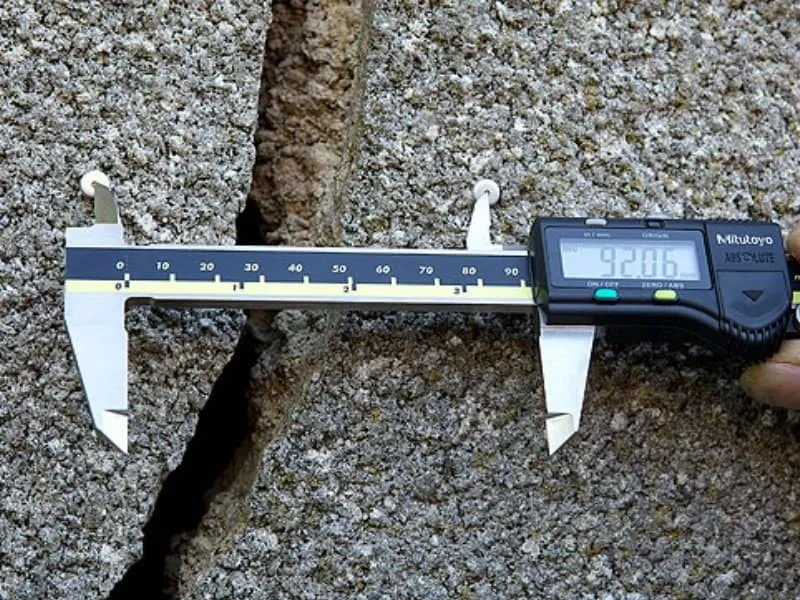
Demec studs. Small studs are fixed either side of the crack and the distance between them is read with a digital gauge to a hundredth of a millimetre. This is the most common method and the one insurers and engineers know best.
Tell-tale gauges. A two-part gauge fixed across the crack gives a visual reference on site. Useful alongside Demec readings, and for anyone checking between visits.
Automated sensors. Displacement sensors read continuously and send data to a web dashboard, with email alerts when movement passes a threshold you set.
When monitoring is worth doing
Consider monitoring if cracks are growing, if you are in a subsidence claim, if work is starting next door (a basement, extension or demolition), or if a structural engineer has recommended it. It is also commonly required under party wall agreements and during underpinning, tunnelling or large excavations. For wider movement of the whole structure, see structural movement monitoring.
How it works
Install and baseline
We agree monitor locations with you, install studs, tell-tales or sensors, and take the baseline reading. Homeowners get a walk-through of what we have installed.
Periodic readings
We return at the agreed frequency, usually fortnightly or monthly, and record every monitor against the baseline. Automated systems read continuously with no site visit.
Reporting
After each visit you receive updated graphs, photographs and a plain written summary. Any monitor over threshold triggers an alert.
Conclusion or escalation
At the end we issue a final report. If movement is progressing, we flag it early and recommend next steps.
Who we work with
Structural engineers and party wall surveyors
Traceable data written to be referenced in expert opinions, schedules of condition and party wall awards.
Insurers and loss adjusters
Independent evidence of whether movement is progressive, seasonal or stable, to support remediation decisions.
Contractors
Pre-works baselines and monitoring through basement, underpinning and demolition works, to evidence that neighbours were not damaged.
Homeowners
Clear, factual answers on whether a crack is getting worse, in plain English that insurers and engineers also accept.
What clients say
Read our reviews on Google★★★★★
We have used THS Concepts for multiple surveys from topographic to drone photogrametry, they are professional and prompt and deliver exactly what is requested. Highly recommended.
★★★★★
I contacted Tom to carry out a Topographic survey, and cannot recommend them enough. Nothing was to much, and I was kept up to date with everything as it happened! Great company to deal with and reasonably priced.
★★★★★
Superb service, quick turnaround and extremely helpful! I wouldn't hesitate to use THS Concepts again if I need to in the future!
Crack monitoring: common questions
I have noticed a crack in my wall. Should I be worried?
Most cracks are cosmetic and stable, caused by seasonal movement, plaster shrinkage or settlement in newer buildings. Cracks worth investigating are usually wider than about 3mm, run diagonally, appear suddenly or get visibly worse over weeks. Monitoring is the only reliable way to tell. Send us a photo with a ruler alongside and we will tell you honestly whether monitoring is worthwhile.
Manual or automated monitoring?
Most projects are well served by manual Demec or tell-tale readings taken fortnightly or monthly. Automated sensors make sense when you need readings more often than weekly, the site is hard to reach, tolerances are tight, or you want instant alerts. We will recommend the lighter option if it gives you the answer you need.
Will my insurer accept your reports?
Yes. Reports include baseline and subsequent readings, graphs, photographs, monitor locations on a CAD plan and a written summary, to the standard UK insurers and engineers expect. If your insurer has specific requirements, tell us and we will match them.
How long does crack monitoring take?
Most schemes run three to twelve months, long enough to capture seasonal movement. Clay soils behave very differently in summer and winter, so subsidence cases usually need a full year. Construction monitoring may only run for the length of the works.
Can I monitor a crack myself?
For a low-stakes cosmetic crack, a tell-tale gauge and dated monthly photos give a rough idea. For anything involving insurance, a party wall award or an engineer's decision, you need independent monitoring with traceable equipment. Our guide on how to monitor a crack covers the DIY route.
How quickly can you start?
For sites within about two hours of our office in Leigh-on-Sea, Essex, including London and the South East, we can usually attend within five working days of instruction.
Related services
- Measured building surveys
Floor plans, elevations and sections of existing buildings.
- Setting out
Gridlines, foundations, piles and roads set out on site.
Tell us about your site
Send a location, a rough brief and your deadline. We reply with a fixed quote within 24 hours.