
Need it done by a professional? THS Concepts carries out crack monitoring for architects, engineers and contractors.
Tell-tale gauges only tell you something once you have a run of readings, and a page of handwritten numbers is hard to read. This free spreadsheet does the sums for you: enter each reading and it works out how far every crack has moved since you fitted the gauges, flags anything that needs a closer look and plots the results on a chart.
Download the record sheet (Excel, free)
It works in Excel, Google Sheets and LibreOffice, and covers up to 10 tell-tales and a year of weekly readings.
What is in the spreadsheet
- Setup: the property, and where each tell-tale is fitted, with the crack width when you fitted it. The BRE Digest 251 damage category fills in by itself.
- Readings: one row each time you read the gauges, with the horizontal (X) and vertical (Y) scale for every tell-tale, plus the weather.
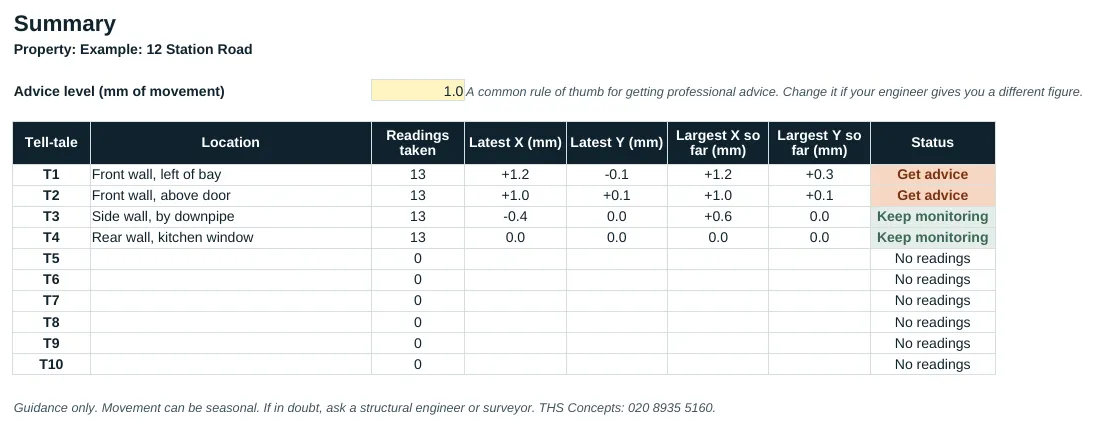
- Movement: how far each tell-tale has moved since the first reading. Anything at or over the advice level is highlighted.
- Summary: the latest and largest movement for each tell-tale, and a status of “Keep monitoring” or “Get advice”.
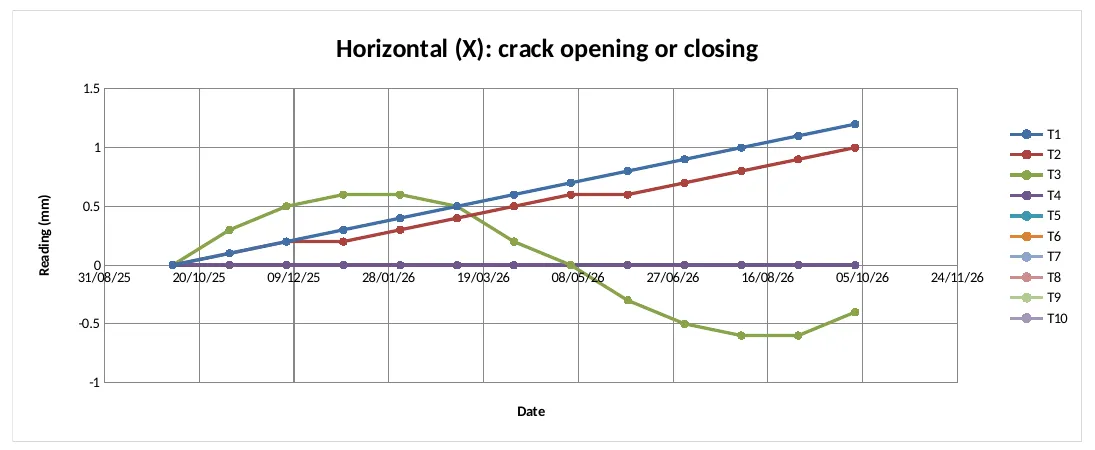
- Charts: every tell-tale plotted over time, so you can see whether a crack is steady, opening and closing with the seasons, or still moving.
How to use it
- Fit your tell-tales across the cracks you want to watch. Our guide on how to monitor a crack shows how to fit and read them.
- Fill in the Setup sheet with where each tell-tale is and how wide the crack is.
- Take the first reading on the day you fit them. This goes in the shaded baseline row on the Readings sheet, and every later reading is measured against it.
- Read the gauges every two to four weeks and add a new row each time. Record both scales to one decimal place, including minus signs.
- Check the Summary sheet. If a tell-tale shows “Get advice”, or a crack keeps widening, have it looked at.
Reading the results
Most cracks move a little with the seasons, particularly on clay soils, opening in dry summers and closing in wet winters. That shows up on the chart as a gentle wave and is usually nothing to worry about. A line that keeps climbing in one direction means the crack is still opening. That is the pattern that needs a professional view, especially alongside other signs of structural movement such as sticking doors or sloping floors. If the movement is across the whole building rather than at one crack, read our guide to monitoring building settlement.
Need tell-tales?
Our THSC10 crack monitoring kit has ten tell-tale gauges, shims for uneven walls, a non-hazardous adhesive, fixings and a crack width card, with free UK delivery.
If you would rather have independent readings and a report, for an insurer, a party wall award or a structural engineer, our crack monitoring service fits Demec studs or tell-tales and reports the results. You can also see what it costs in our structural monitoring costs guide.