
Vibration monitoring to BS 7385 and BS 5228
Remote vibration monitoring for piling, demolition, compaction and breaking-out works. Tri-axial geophones record peak particle velocity to BS 7385 and BS 5228, with alerts around the clock.
Why monitor vibration
Piling, demolition and heavy plant send vibration into the ground and neighbouring buildings. Most of it is harmless, but neighbours notice it, engineers need to know it stays within limits, and if a claim is made later, a continuous record of what was actually transmitted is the best evidence anyone can have.
How it works
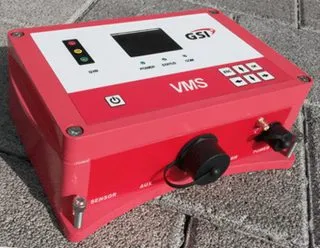
We install tri-axial geophones at the buildings or boundaries most at risk. They record peak particle velocity continuously in line with BS 7385 and BS 5228, and send data remotely so there is no need for daily site visits. Alarm thresholds are set in agreement with the structural engineer or party wall surveyor, and if one is passed, the named contacts get an SMS and email straight away, day or night.
Typical projects
From small basement builds to large earthworks, we install schemes for excavation, demolition, piling and tunnelling works across London and the UK, often alongside movement and crack monitoring on the same site.
How it works
Specification
We agree monitor positions and alarm thresholds with the structural engineer or party wall surveyor, or propose them for approval.
Installation
Monitors are fixed to the structures or boundaries at risk, set up for remote data and tested before works start.
Monitoring and alerts
Readings are recorded continuously. If a threshold is passed, the named contacts are alerted by SMS and email straight away.
Who we work with
Piling and groundworks contractors
Evidence that bored, CFA or mini-piling stayed within agreed limits at neighbouring buildings.
Demolition contractors
Monitoring of retained and adjoining structures during breaking-out and demolition.
Party wall surveyors
Thresholds and records that fit straight into a party wall award.
What clients say
Read our reviews on Google★★★★★
We have used THS Concepts for multiple surveys from topographic to drone photogrametry, they are professional and prompt and deliver exactly what is requested. Highly recommended.
★★★★★
We was looking for a local company to survey our setting out on our new build project and came across THS, We are VERY happy with the service they provided, Tom visited the site and was very helpful and professional. providing a detailed description and was very thorough. we will defiantly be using THS in the near future.
★★★★★
I contacted Tom to carry out a Topographic survey, and cannot recommend them enough. Nothing was to much, and I was kept up to date with everything as it happened! Great company to deal with and reasonably priced.
Vibration monitoring: common questions
What does a vibration monitor measure?
Peak particle velocity (PPV), the speed at which the ground or structure moves as vibration passes through it, recorded in three directions by a tri-axial geophone. PPV is the measure used in BS 7385 and BS 5228 to judge the risk of damage and disturbance.
Which works need vibration monitoring?
Piling, demolition, vibratory compaction, breaking-out and tunnelling near sensitive buildings. It is often a condition of a party wall award, a planning consent or a third-party asset agreement.
Who sets the alarm thresholds?
The structural engineer or party wall surveyor, based on the structures at risk and the relevant standards. We can propose values for their approval.
Can it run alongside movement monitoring?
Yes, and it often does. Prism monitoring of structures is commonly combined with vibration monitoring at neighbour boundaries during piling and demolition. See structural movement monitoring.
Related services
- Setting out
Gridlines, foundations, piles and roads set out on site.
- 3D laser scanning
Point clouds and BIM models of buildings, plant and structures.
Tell us about your site
Send a location, a rough brief and your deadline. We reply with a fixed quote within 24 hours.