
Automated total station monitoring
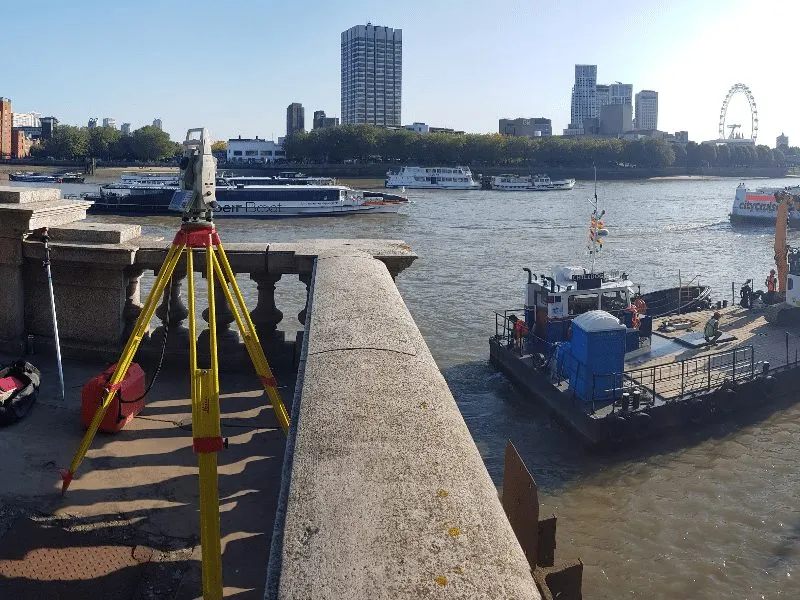
A robotic total station in a fixed enclosure reads a network of prisms on a schedule, often hourly, uploading 3D movement to a dashboard and alerting the team the moment a trigger is breached.
Monitoring without a site visit
On higher-risk works, waiting a week for the next manual reading is not good enough. An automated total station sits in a secure enclosure on or near the site and reads a network of prisms on a schedule, usually hourly. Data uploads to our in-house dashboard, which clients and stakeholders can access easily, and if movement passes a trigger, alerts go out straight away.
Where it is used
Deep basements and excavations next to sensitive buildings, works near rail, tunnel and water assets with asset protection agreements (see monitoring tunnels and rail assets), and long programmes where weekend or night access is restricted.
Prism layout and reading frequency
The engineer’s specification sets which structures need watching, and we design the prism network around it: prisms on each face and level of the structures at risk, reference prisms on stable ground well outside the zone of influence, and an instrument position with a clear view of both. Reading frequency is set by risk, often hourly through excavation or demolition, and can be changed remotely when work moves into a critical stage. Each cycle measures the reference prisms first, so the instrument’s own position is checked every time.
Working with manual monitoring
Most schemes mix methods. Automated stations cover the most critical points continuously, while precise levelling, crack and tilt monitoring cover the rest. See remote monitoring and alerts for how data and alerts reach your team.
How it works
Design the network
We agree instrument position, prism locations, reading frequency and triggers with the engineer.
Install and baseline
The instrument, prisms and communications are installed and a baseline is established before works start.
Monitor around the clock
Readings run automatically. The dashboard updates and alerts go out without anyone on site.
Who we work with
Structural and temporary works engineers
Near real-time data on higher-risk works.
Infrastructure asset owners
Continuous monitoring to satisfy asset protection agreements.
Main contractors
Round-the-clock cover where weekend or night access is restricted.
Where we work
From our base in Leigh-on-Sea, Essex, we carry out automated total station monitoring across London, Essex, Kent, Hertfordshire and the rest of the UK. Local pages:
What clients say
Read all 90+ reviews on Google★★★★★
THS Concepts carried out movement monitoring for us during a large renovation in Leigh on Sea, needed as part of our party wall awards. Reliable readings throughout, kept us updated regularly and gave us real peace of mind during the works. Would recommend!
★★★★★
THS Concepts provided Echo Construction Group with regular movement monitoring surveys which have been off great use during our basement excavation works and recommend them!
★★★★★
Truly excellent Company and Staff. I tendered several Monitoring companies and THS Concepts communication via email was perfect. The Fees were reasonable and I was more than comfortable going ahead with them. …
Automated total station monitoring: common questions
When is automated monitoring worth it?
On higher-risk works, long programmes, sites with restricted access, and where an asset owner requires continuous data. For lower-risk residential work, manual monitoring visits are usually more cost-effective.
How often are readings taken?
Typically every hour, and more often during critical operations. The frequency can be changed remotely.
What accuracy does it achieve?
Similar to manual total station monitoring, around ±1mm in 3D at normal distances, with the advantage of continuous data.
Related services
- 3D laser scanning
Point clouds and BIM models of buildings, plant and structures.
- Setting out
Gridlines, foundations, piles and roads set out on site.
Tell us about your site
Send a location, a rough brief and your deadline. We reply with a fixed quote within one working day.