
Sale – 10% Off All Services – Get Your Quote Today – Expires Soon.
In collaboration with Party Wall Surveyors and Building Contractors across London and the South East, we specialise in precision crack monitoring, employing gauges and demec studs and automated solutions to accurately track crack movement over time.
Are you aware of your specific needs and/or wish to include files? Please complete our detailed form here.
THS Concepts are an accredited member of The Survey Association body.
We operate nationwide across the United Kingdom.
THS Concepts was formed over 10 years ago in 2013.
£1 million in liability cover, employers' and public liability insurance.
We take great pride in our exceptional 5-star ratings on both Google and Trustpilot
THS Concepts helps building contractors with their crack monitoring requirements. We setup crack monitoring schemes and monitor crack widths over time. Following each survey, we provide easy to understand graphs and reports.
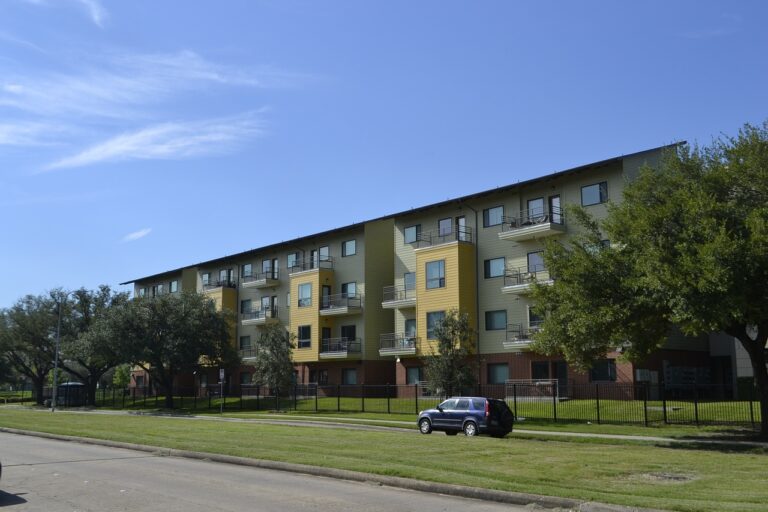
Our crack monitoring service is typically utilised where building work is being undertaken or subsidence is occurring. The crack monitoring data and reports can help satisfy key requirements and agreements associated with the works.
We have completed and advised on several different projects that have required crack monitoring. We work alongside Party Wall Surveyors and Engineers to ensure that the process is undertaken correctly.
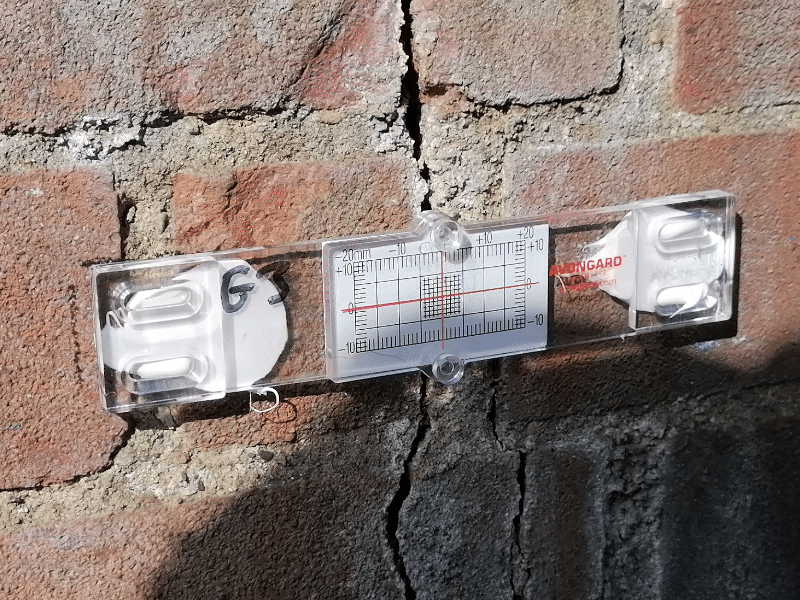
Our experienced monitoring surveyors set up and install the initial crack monitoring. We use studs and gauges to precisely measure crack distances and advise if they are opening or closing.
Following your survey, you receive your DWG CAD file showing plans, elevations, sections etc. The drawings will be presented in an organised, easy-to-manipulate format.
Following each survey, you will receive ongoing reports and graphs clearly illustrating the results of the crack monitoring. You will be able to compare movement over time and be automatically informed if the movement is beyond its set limit.
Our surveyor takes plenty of photos on site, which are often useful during your project. We can send these in an easy-to-download Dropbox Link.
We ensure you are 100% satisfied with the drawings and service we provide. Updates and amendments are no problem and are undertaken quickly to get your project moving.
We love helping you with projects! If you have an issue with CAD or need some tips to work effectively then we are quite happy to help, free of charge.
Crack monitoring services are often employed across various project types to assess and track structural changes. Our experience includes working on diverse projects of different sizes, with typical applications including:
Basement Construction: Monitoring cracks during basement construction can help identify potential issues related to excavation, ground movement, or changes in load distribution.
Underpinning: Crack monitoring is essential during underpinning projects, as it ensures that the process of strengthening a building’s foundation is progressing safely and effectively, without causing further damage.
Heavy Nearby Demolition: Monitoring cracks in structures adjacent to demolition sites can help detect any damage caused by vibrations, ground movement, or changes in load bearing during the demolition process.
Earth Movement Projects: In projects involving significant earth movement, such as tunneling or excavation, crack monitoring can help identify shifts in structures that may lead to potential issues or damage.
Settlement and Deformation: Monitoring cracks in buildings prone to settlement or deformation can provide valuable insights into structural stability, enabling timely intervention and informed maintenance decisions.
Crack monitoring and reporting services are designed to track and document the movement of cracks in buildings over time. By accurately measuring and recording any changes, professionals can identify structural issues, assess the need for intervention, and determine the most effective repair strategies. This information helps ensure the safety, stability, and longevity of the building while protecting its occupants and assets.
The crack monitoring process involves installing precise measuring instruments, such as gauges or pins, at the site of the crack. These devices track changes in the crack’s width and movement over time, with regular inspections conducted to record the data. The gathered information is then analysed by experts to identify any trends, assess structural stability, and inform repair or maintenance decisions.
We have written a brief guide on how to monitor cracks if you are looking to do this yourself.
You should consider using a crack monitoring service if you have noticed cracks in your building, particularly if they are growing or if the structure is subject to movement. Crack monitoring is also recommended in situations involving disputes or insurance claims related to structural damage, as the accurate data collected can provide valuable evidence to support your case.
The duration of the crack monitoring process depends on the specific circumstances of the building and the extent of the cracking. Monitoring may take place over several weeks, months, or even years to gather enough data to identify trends and determine the most appropriate course of action. The process may be shorter or longer depending on the building’s unique conditions and the requirements of the project.
Yes, crack monitoring and reporting services can assist with insurance claims related to structural damage. By providing accurate, reliable data on crack movement and progression, these services offer valuable evidence to support your claim. This evidence can help demonstrate the extent of the damage, the cause, and the potential costs associated with repairs, ensuring that you receive the appropriate compensation.
Crack monitoring and reporting services are suitable for both residential and commercial buildings. Regardless of the building type, monitoring and reporting on crack movement is essential for ensuring structural stability, safety, and the protection of assets. These services are tailored to the specific needs and requirements of each project, providing valuable insights and guidance for building owners, managers, and contractors.
Crack monitoring relies on a variety of specialised equipment designed to accurately track and measure changes in cracks over time.
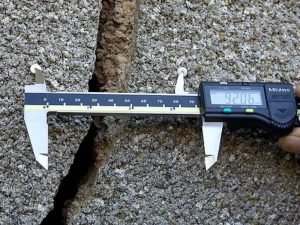
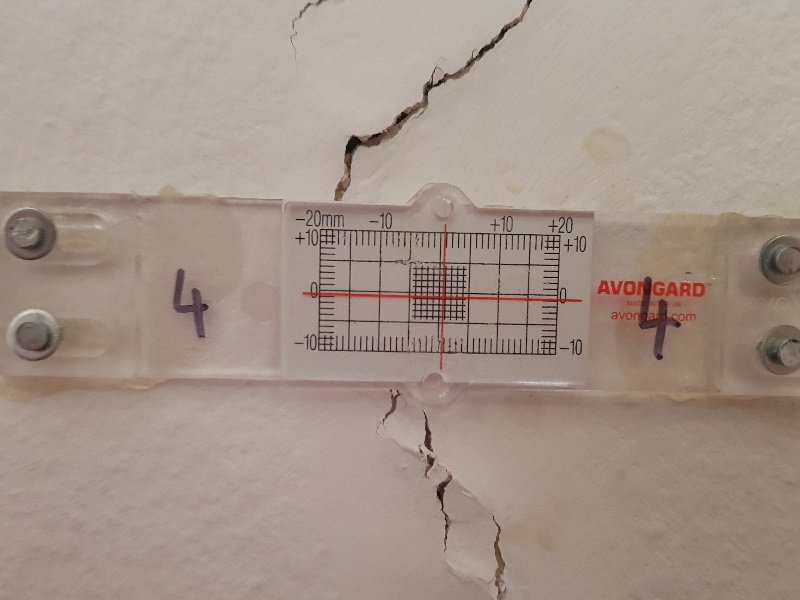
Demec studs, for example, are installed on either side of a crack, allowing for precise measurements of its width using a demountable mechanical gauge. This gauge records any changes in crack width, providing valuable data on movement and progression.
Crack gauges come in a variety of different products designed for varying applications. The basic premise is that you glue or mechanically fix the gauge either side of a crack using glue or mechanical fixings. Over time the crack opens and closes, the movement is then illustrated on the gauge.
Additionally, automated crack monitoring systems can be employed for continuous, real-time tracking of crack activity. These advanced systems use sensors, data loggers, and software to monitor cracks, providing consistent, up-to-date information on their status and enabling timely intervention when required.
The use of such equipment ensures accurate, reliable data collection and analysis, essential for maintaining structural integrity and safety in various construction applications.

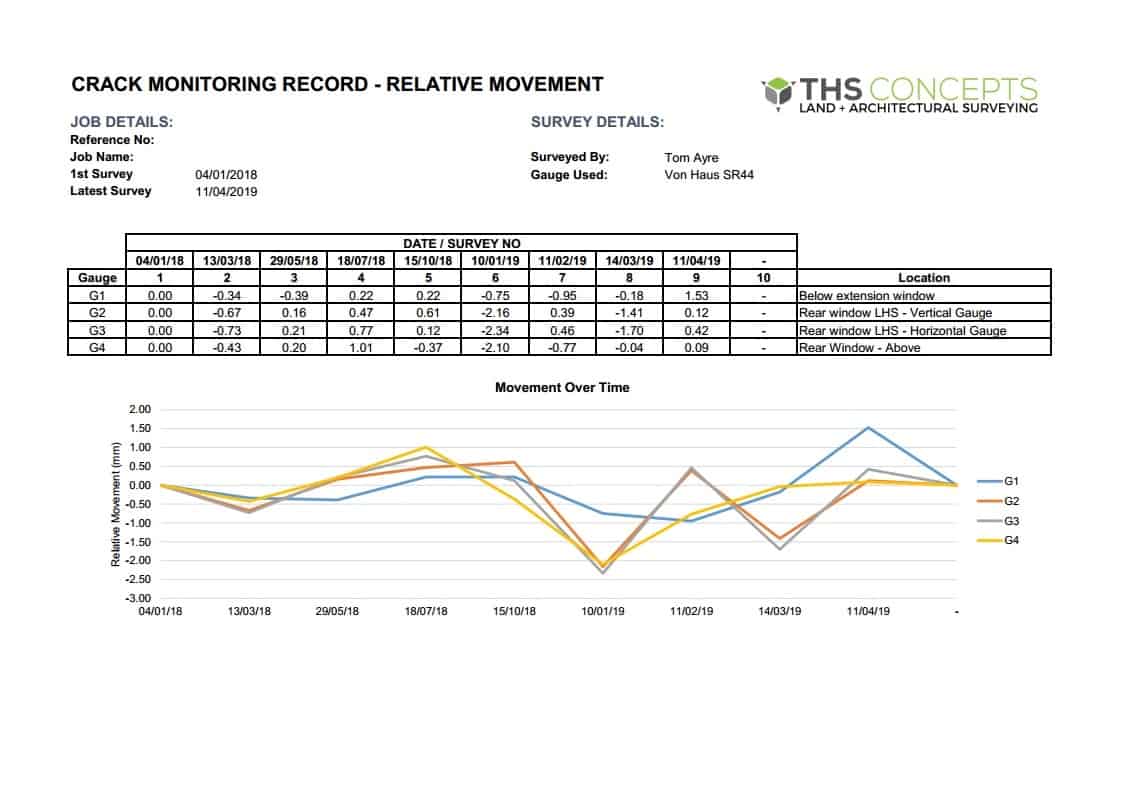

We monitor fixed locations on buildings and structures for moving up in elevation and plan. We issue easy-to-understand reports outlining movement over time.
We install tilt sensors on walls that need to be monitored for angular movement. Our tilt sensors work remotely and can report readings as often as every minute!
92 Bellhouse Lane, Leigh-on-Sea, Southend-On-Sea, Essex, SS9 4PQ
76 Quill Street, Finsbury Park, London, N4 2AD
THS Concepts has a passionate team of surveyors and CAD draughtsman delivering detailed, thorough and accurate surveys and CAD drawings. We are far more than just a land and building surveying company.
Terms & Conditions | XML Sitemap | Copyright 2022 – THS Concepts LTD